
Antenna Cable Connector Guide
Posted by Steve Kennedy - VK6SJ
Antenna Cable Connector Guide: PL-259, N-Type, BNC and SMA – Which One Fits Your Coax?
A fella came up to the counter last summer with a brand-new handheld in one hand and a mag-mount antenna in the other. The antenna lead ended in a big chunky PL-259. The radio had a tiny SMA socket barely wider than a pencil. "Surely there's a trick to this," he said. There is. It's called the right antenna cable connector, and he didn't have one.
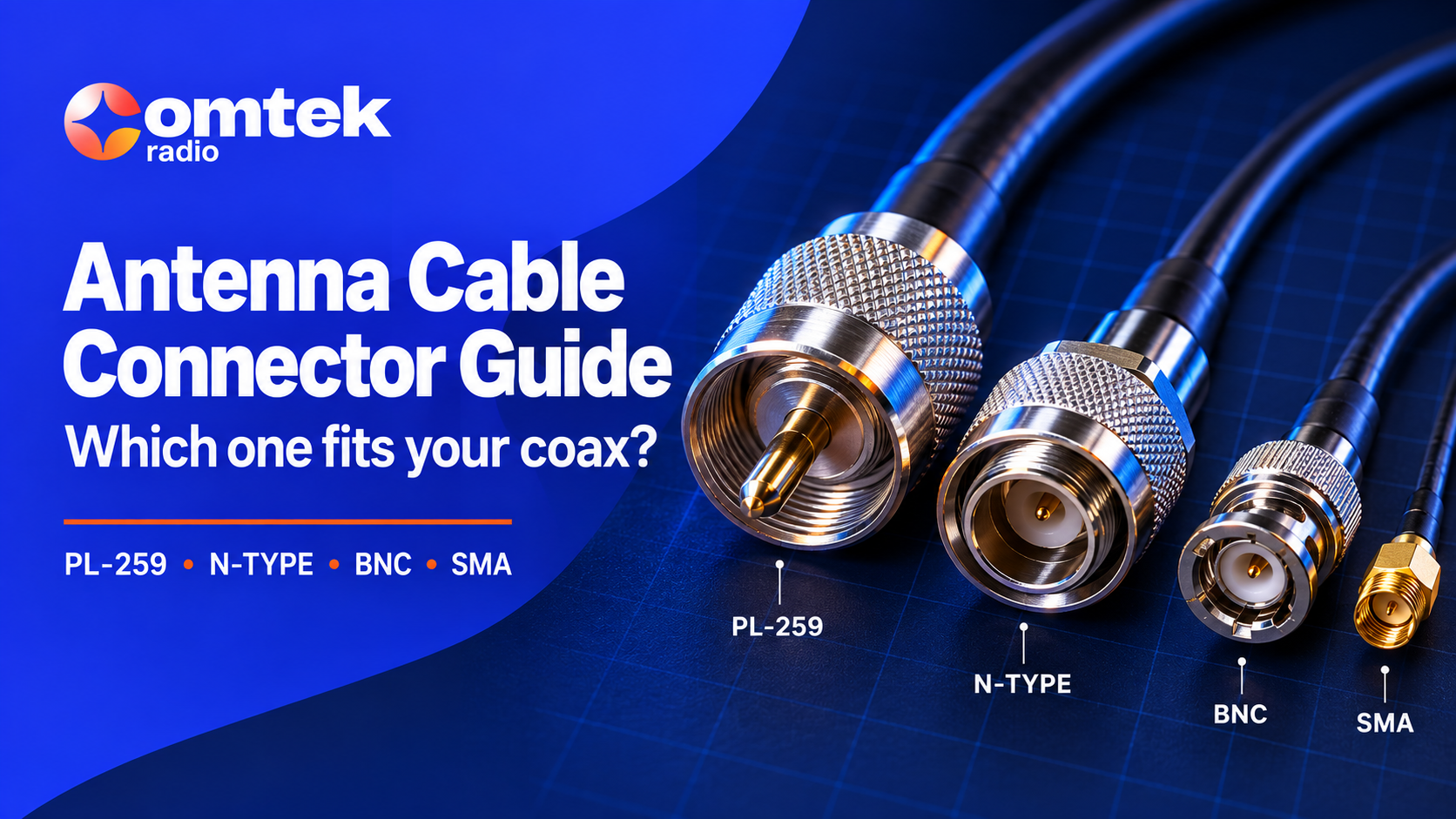
That conversation happens more than you'd think. People blame the radio. Then the antenna. Then the coax. Nine times out of ten the real trouble lives in the few centimetres where the cable meets the plug. A connector that doesn't suit the cable, the band or the weather will quietly cost you signal for months before anyone thinks to look at it.
This guide walks through the antenna connector types you'll actually meet in an Australian shack, ute or 4WD: the PL-259 and SO-239 pair, N-type, BNC and SMA. You'll find out which one your radio probably uses and how male and female really work. We'll also cover when an adaptor is a sensible fix (and when it's a bodge), plus how to pick the right crimp for RG58, LL240 or LL400.
Quick comparison
Here's a quick look at the four rf connector types you'll handle most in amateur and UHF CB work.
|
Connector |
Connection style |
Typical use |
Good on which coax? |
Weatherproof? |
Watch out for |
|
PL-259 / SO-239 ("UHF") |
Threaded coupling nut |
HF rigs, UHF CB mobiles, base stations, 2 m |
RG58 (with the right reducer), LL240, LL400 |
No, it needs tape or a boot. |
Performance drops as frequency climbs; sloppy fitting |
|
N-type |
Threaded, with gasket |
70 cm and up, masthead joins, long outdoor runs |
LL240, LL400 |
Better, but still seal it |
Bulkier and fiddlier to fit; overkill on short HF leads |
|
BNC |
Bayonet twist-lock |
Test gear, scanners, older handhelds |
RG58 and thinner |
No |
Low power only; worn bayonets go intermittent. |
|
SMA |
Small threaded |
Modern handhelds, SDR dongles |
Thin cable and pigtails |
No |
Fragile; the RP-SMA gender trap; easy to over-tighten |
Before we go any further, the gender question, because it trips up nearly everyone. On most RF connectors the male has the centre pin sticking out and the female has the socket that receives it. That's the whole rule. So when a part is sold as a "male to female adapter", one end has a pin and the other has a socket.
SMA has a sneaky twist. Reverse-polarity SMA (RP-SMA) swaps the centre over, so an RP-SMA "male" still has the coupling nut of a male (thread on the inside) but a hole in the middle instead of a pin. You'll see it on Wi-Fi gear and some cheap imported antennas. Don't trust the label on the bag. Look at the centre (pin or hole) and the thread (inside or outside), and match both.
What connector does my radio use?
Look at the socket on the radio and compare it with the plug on your antenna lead. Most HF and mobile or base rigs have an SO-239 jack. Many handhelds use SMA. Scanners and older gear often use BNC, and outdoor or higher-frequency equipment often uses N-type. The manual or the maker's spec sheet will confirm it.
Of all the antenna jack types, the SO-239 is the easiest to spot. It's a solid, square-flanged socket on the back of most HF transceivers and UHF CB mobiles, with a thread on the outside and a hole in the middle. BNC is the one with two little lugs on the side that a twist-lock collar grabs. SMA is tiny and threaded. N-type looks a bit like a slimmer, tidier cousin of the SO-239 and screws on firmly.
Handhelds are where the confusion starts. Some put the female SMA on the radio and expect a male on the antenna. Others do it the other way round. Same connector family, opposite genders, and they won't mate. So check yours rather than going on what a mate's radio has.
I had a new Foundation licensee in a while back who'd ordered a nice whip online for his first handheld. It wouldn't screw on. He'd tried "a bit harder" twice, which is never the answer with SMA. Turned out the whip was RP-SMA. Pin and hole didn't line up, threads looked about right, and the little centre contact on his radio was lucky to survive. Two minutes with a torch and he could see the problem himself.
When the radio and the antenna don't match, you've got two choices:
- A quick fix: a male to female adapter, or a female antenna adapter that puts the right socket on the end of your lead. Good for trying an antenna or for portable work.
- A permanent fix: a proper lead with the correct antenna cable connector on each end. Better for anything that stays put.
A quality adaptor is fine for plenty of jobs. Just remember every adaptor is one more joint that can add a little loss, a little mismatch, an intermittent contact or a path for water. The effect gets worse as frequency goes up.
And please don't stack them. I once traced a mobile install where the owner had three adaptors bolted together behind the radio to make an old lead fit. The SWR (standing wave ratio, a measure of how much power bounces back instead of going out the antenna) jumped around every time the ute hit a bump. Nothing made sense until we pulled the whole tower of adaptors off and fitted one proper lead. Problem gone. He kept the adaptors "just in case", which is how they end up back in service.
If you need to sort out a mismatch, our range of antenna connectors and adaptors covers the common combinations. SMA is also the usual socket on SDR dongles, so if you're getting into those, our introduction to software defined radio is a good next read.
PL-259 vs SO-239: what's the difference?
The PL-259 is the plug that goes on the end of the coax. The SO-239 is the socket, or jack, fitted to the radio, antenna base, switch or meter. They're two halves of the same "UHF" connector family, and the PL-259's coupling nut screws onto the SO-239's outside thread to hold them together.
When people ask about antenna plug types, the PL-259 is usually the one in their hand. It comes in two main styles. The soldered kind has small holes in the body where you solder the braid, then you solder the centre conductor into the pin. The crimp kind uses a ferrule that you squash over the braid with a crimp tool. Both work well when done properly. Both fail in predictable ways when they're rushed.
Now, about that "UHF" name. It's historical and a bit misleading. It dates back to when anything above the HF bands counted as high frequency, and by today's standards these connectors aren't great at UHF. The reason comes down to impedance, which is basically how the cable and connector resist the signal. Nearly all ham gear is built around 50 ohms. A PL-259 and SO-239 pair isn't a constant 50-ohm design all the way through, and that small mismatch matters more the higher you go.
So why are they still everywhere? Because they're tough, cheap and easy to fit. On HF they're perfectly good. On 2 m they're acceptable. Most UHF CB mobiles use them too, and on a short, well-made run in a vehicle they do the job. You'll also find SO-239 sockets on most meters, dummy loads and antenna switches, which is part of why the family refuses to die.
Need to join two leads that both end in PL-259s? That's what a female to female antenna adapter is for. In this case it's a double-female SO-239 barrel, with a socket at each end. Indoors it's a perfectly reasonable join. Outdoors it's a weak spot, because neither the barrel nor the plugs are weatherproof on their own. Seal it properly or water will find it.
The usual fitting mistakes are boringly consistent:
- A stray strand of braid touching the centre pin.
- Cold or blobby solder that looks fine and isn't.
- A coupling nut that's only finger-loose, so the joint moves.
That first one bit a UHF CB install I looked at a few years ago. The radio kept dropping out on corrugated roads. Receive faded, transmit SWR spiked, then everything came good again. The PL-259 behind the dash had one fine strand of braid curled toward the centre pin. Sitting still, it didn't touch. Over corrugations, it did. Looked fine. Worked for a week. Then the road got rough. Ten minutes to refit the plug and it was cured.
When should I use N-type?
Use N-type for 70 cm and above, long outdoor runs, masthead or other outdoor joins, higher power and thick low-loss cable like LL400. It's a constant 50-ohm design with a gasket, so it holds its performance better as frequency climbs and stands up to the weather better than the UHF family.
Of all the common rf connector types, N-type is the one I'd reach for anywhere the signal is working hard or the joint lives outside. On 70 cm the difference starts to show. On the bands above it, it's the sensible default. It also suits thick cable like LL400, which is exactly what you'll be running for a long feed up a mast where every bit of loss counts.
The gasket helps, but don't treat it as a free pass. Australian conditions are hard on anything outdoors. Our sun cooks cheap electrical tape until it goes brittle and peels off in strips, usually inside a summer. Near the coast, salt air turns bare connector bodies green and crusty faster than people expect. Inland, fine red dust gets into everything. Heat cycling in vehicles and on tin roofs makes joints breathe, pulling moisture in overnight.
So even with N-type, seal outdoor joins. A good habit is self-amalgamating tape first, then UV-resistant tape over the top, or a proper weatherproof boot. Leave a little drip loop below the join so water runs off rather than down into it.
Now the honest bit. N-type is overkill for a short indoor HF patch lead between the radio and a tuner. It's bigger, fiddlier to fit and costs more. On HF, a well-made PL-259 lead is all you need. Save the N-type for where it earns its keep, and match it to the right antennas and feedline for the band you're running.
Which crimp fits RG58, LL240 or LL400?
Each cable needs a connector made for its exact size and construction, plus the crimp die that matches that connector. RG58, LL240 and LL400 are different diameters, so their connectors aren't interchangeable. Read the cable type printed on the jacket, then buy the connector and die made for that cable.
In plain terms, here's how they size up:
- RG58 is thin, around 5 mm across. Flexible, handy for short leads and lower power, but lossy over long runs.
- LL240 is low-loss cable in the RG8X or 240 size class, around 6 mm. A good middle ground for mobiles and moderate runs.
- LL400 is thick low-loss cable in the 400 class, around 10 mm. Much lower loss, much stiffer, and the one for long feeds and higher bands.
The jump from 5 mm to 6 mm doesn't sound like much. It's plenty to ruin a crimp. The classic mistake is grabbing an RG58 connector and forcing it onto LL240 because it "nearly fits". I've had one of those on the bench. Someone had trimmed back the jacket to make it go, then closed the ferrule with pliers because the proper die wouldn't. It measured fine the day it was fitted. A few weeks later the braid had worked loose and the SWR was wandering all over the place. Nearly fits is the same as doesn't fit. It just takes longer to find out.
A few habits that save grief:
- Use the strip lengths from the connector maker's sheet. Every connector design is a little different, so don't guess.
- Match the die to the connector maker's spec. Different brands of connector for the same cable can call for different dies.
- Centre pin, crimp or solder: both work if the pin is fully seated. Crimp is quicker and consistent. Solder suits some pins and some people. Whichever you choose, don't leave the pin sitting proud or sunk.
- Test before you trust it. With a multimeter, check there's continuity centre pin to centre pin and braid to braid, and no short between centre and braid. Then do an SWR check on the air before calling the job done.
If you're still deciding on cable, our coax cable range (RG58, LL240, LL400) lists what each type is. The right antenna cable connector always starts with knowing exactly which coax you've got.
Match the Connector to the Coax, Not the Other Way Round
Here's the short version. Know your coax first. Pick the antenna cable connector made for that cable and that job. Use N-type where the frequency is high or the join is outdoors, PL-259 where it's HF and rugged matters, and check pin and thread on anything SMA. Treat adaptors as a quick fix, not a lifestyle. And seal anything that lives outside, because the Australian weather will find every gap you leave.
Most of the antenna connector types in this guide will do a great job when they're fitted carefully to the right cable. They only become a problem when someone takes a shortcut. Most SWR mysteries end at a connector. Usually one somebody fitted in a hurry.
Not sure which antenna cable connector or adaptor you need? Have a look through our connectors range, or contact ComTek Radio on 1300 141 939 or sales@comtekradio.com.au with your radio model and cable type, and we'll help you find the right part.